Herzegovina and Mostar
South of Ivan Pass, Herzegovina tips into the Mediterranean: Mostar and its Stari Most, Blagaj, Počitelj and the vineyards of Trebinje, best explored outside peak season.
Herzegovina begins at Ivan Pass, at 967 metres altitude, where the road from Sarajevo tips toward the Mediterranean. Within twenty kilometres, the landscape shifts: pine forests give way to white limestone karst, vine, fig and pomegranate. The climate follows the same logic. When Sarajevo reads 22°C in May, Mostar already shows 28. This climatic boundary structures the region and shapes its cuisine, architecture and pace of life—closer to neighbouring Dalmatia than to the rest of Bosnie.
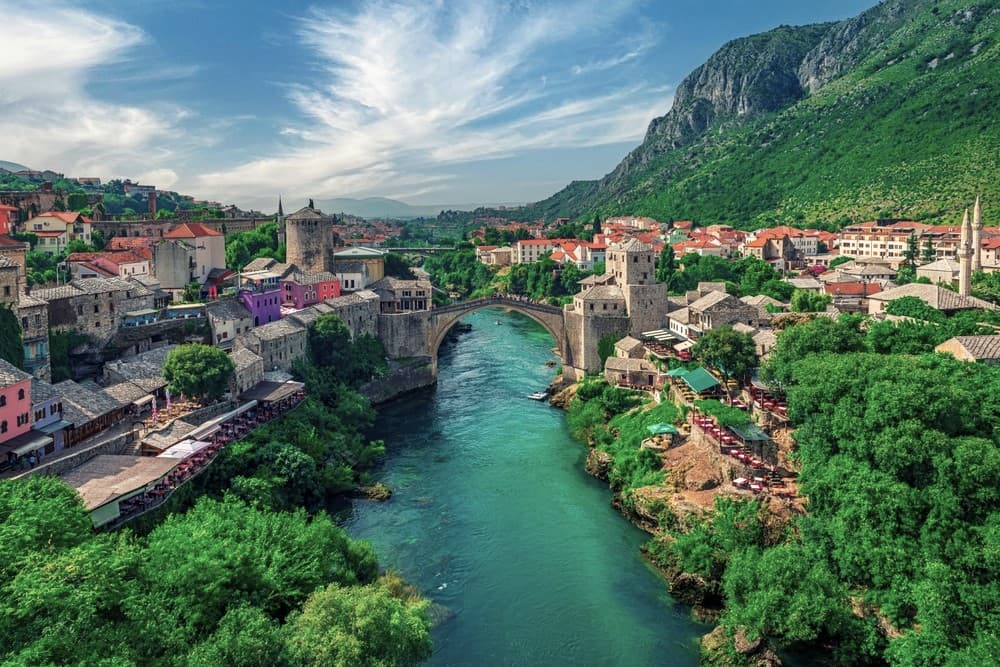
Mostar remains the pivot. The Stari Most, a 16th-century Ottoman bridge destroyed in November 1993 and rebuilt stone by stone in 2004, spans the Neretva 21 metres above the water. Around it, the old town paved in cobbles, the copper workshops of Kujundžiluk and the Koski Mehmed-pasha and Karađoz-bey mosques compose a dense Ottoman centre, best explored early morning or after 6pm, when the buses from Dubrovnik and Split have departed. Divers from the Mostari club jump from the bridge April through October, a tradition documented since 1664.
Eight kilometres south, Blagaj shelters the source of the Buna, one of Europe's most powerful karst resurgences, issuing directly from a 200-metre cliff. The tekke, a 16th-century Sufi monastery, nestles against it. Here you sip Bosnian coffee on the wooden terrace, visit the prayer halls of the dervishes, sometimes paddle upstream to the cave entrance. Further south still, Počitelj tiers its stone houses, the Hadži Alija mosque and the Sahat-kula tower on a spur above the Neretva. The village, listed and partly restored after 1990s destruction, hosts a painters' colony each summer.
The region's other pole lies in Trebinje, 130 kilometres south of Mostar, in Republika Srpska. The town sits surrounded by Žilavka and Vranac vineyards, indigenous varietals worked by a dozen estates, including the Orthodox Tvrdoš monastery, which has made wine since the 15th century in the cellars of a former Roman establishment. Century-old planes shade the terraces of Slobode Square, and the Trebišnjica, an underground river for part of its course, flows beneath the Arslanagić bridge, relocated stone by stone in the 1970s.
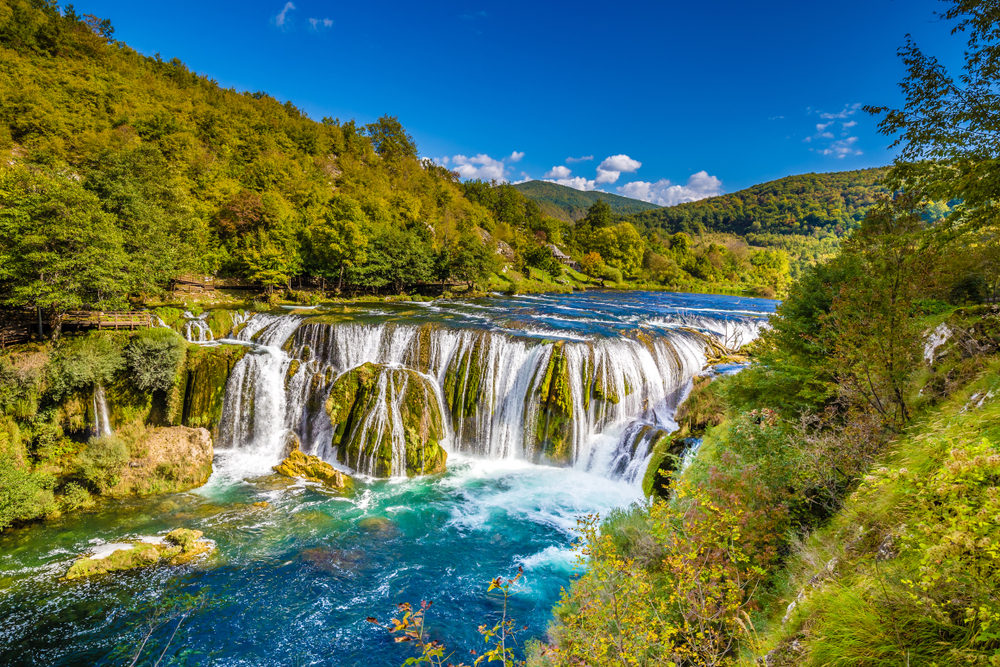
Between these points, the Herzegovinian countryside unfolds as high pastoral plateaus, tobacco valleys around Stolac (where the medieval Radimlja necropolis lines up 133 stećci—Bogomil funerary stelae classed UNESCO), and small emerald streams like the Trebižat at Kravice, where a 25-metre cascade arcs into a swimmable pool. The food is frankly Mediterranean: roasted lamb under the sač at Konjic, japrak (vine leaves stuffed), grilled Buna trout, and sheep's milk cheese production in the villages of Nevesinje.
The human fabric is woven. Mostar splits between a Catholic Croat west bank and a Muslim Bosniak east bank, a divide visible in bell towers and minarets, inheritance of the 1992–1995 war. Trebinje and the Popovo polje valley are predominantly Serbian Orthodox. This diversity, which we address directly with our guides, reads as integral to the region as its landscapes.
To discover
Stari Most and Mostar's old town. The reconstructed Ottoman bridge after 2004, the cobbled lanes of Kujundžiluk and the leaps of local divers from the deck, April through October.
Buna source at Blagaj. The 16th-century Sufi tekke set against a 200-metre cliff, where the river emerges at an average flow of 43 m³/s. Bosnian coffee on the wooden terrace above the water.
Trebinje and the Tvrdoš monastery. Tastings of Žilavka and Vranac in the vaulted cellars of the Orthodox monastery, then plane-shaded terraces on Slobode Square.
Radimlja stećci near Stolac. 133 medieval Bogomil funerary stelae carved with spirals, hunters and figures with raised hands, lined along the Mostar–Čapljina road.
Kravice waterfalls on the Trebižat. A limestone tufa arc 120 metres wide where water falls 25 metres into a pool for swimming June to September, 40 km southwest of Mostar.
When to go
The most comfortable window stretches April to June and September to October. In April–May, temperatures range between 18 and 24°C in Mostar, vines bud at Trebinje, and the Neretva still runs with snowmelt. September and October hover around 22 to 26°C, harvest season and when cruise-ship buses from Dubrovnik thin considerably after 15 September.
July and August run hot: 32 to 35°C by day in Mostar, sometimes 38, with nights dropping to 20°C thanks to karst mass. Stone in the old towns absorbs heat and releases it until midnight. This is the season for swimming at Kravice and on the Neretva, but Mostar's centre between 11am and 5pm is saturated. Winter is mild and rainy, 8 to 12°C in January, with dry bura squalls descending from the mountains. December to February suits those seeking city visits without crowds, though several family hostels in villages close.
Practical advice
Allow three full days for the region: one day in Mostar and Blagaj, one day for Počitelj, Stolac, Radimlja and Kravice, one day descending to Trebinje via the scenic Popovo polje road. Four to five days if you add a tasting at a Vranac vineyard, a walk in the Rakitnica canyon or a night in Konjic for rafting on the Neretva. Logistical entry comes either via Sarajevo (130 km, 2.5 hours' drive or a 2-hour scenic train to Mostar) or Dubrovnik (140 km, 3 hours with border crossing), allowing combination with Croatia. Mostar airport itself sees limited service.
The natural pairing is with Sarajevo and surrounds, heading back up via Ivan Pass, or with Eastern Bosnie and Sutjeska via the Trebinje–Foča road through the Zelengora mountains. Comfort is solid: stone boutique hotels in Mostar's old town, family guesthouses at Blagaj and Trebinje, a few wine estates with rooms. The region suits contemplative travellers, history and food lovers, and families—distances stay short (never more than 90 minutes between stops). Serious hikers will prefer extending toward Sutjeska or Krajina.