Central Bosnia
The Bosna river basin between 500 and 1,000 meters: Ottoman fortresses of Travnik, urban waterfall of Jajce, Franciscan monasteries and highland cheeses of Vlašić.
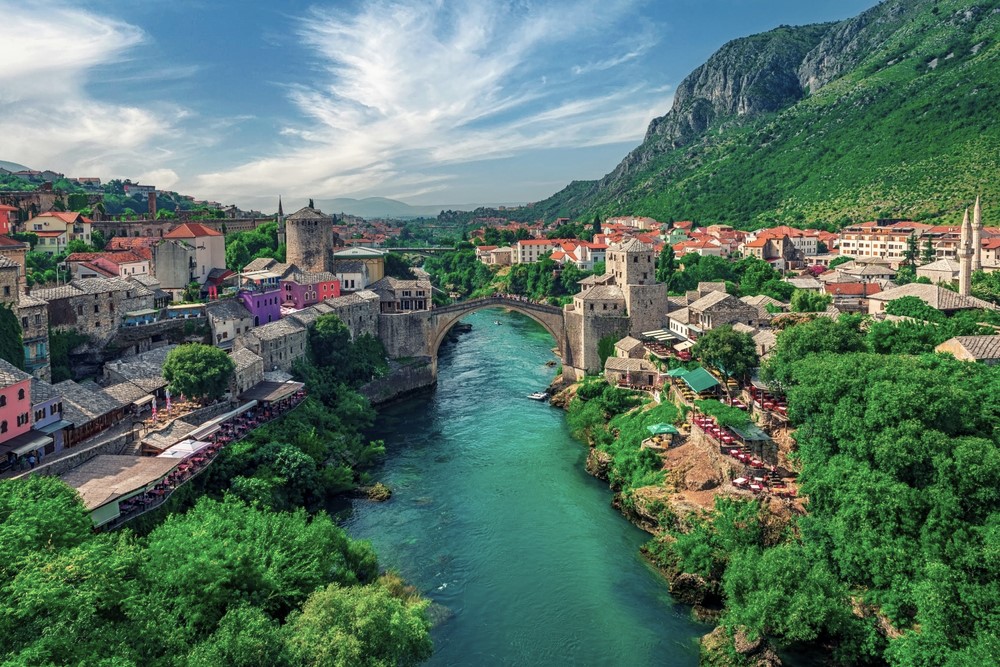
Central Bosnia occupies the basin of the Bosna river and its tributaries, between 500 and 1,000 meters in elevation, framed by the Vlašić massif to the north and Vranica to the southwest. It is the geographical and historical heart of the country, where medieval Bosnian identity was forged before the Ottoman conquest of 1463. Agricultural valleys alternate with karst plateaus, beech and coniferous forests, and a succession of small industrial towns that once sustained Yugoslav steelmaking: Zenica, Kakanj, Vareš.
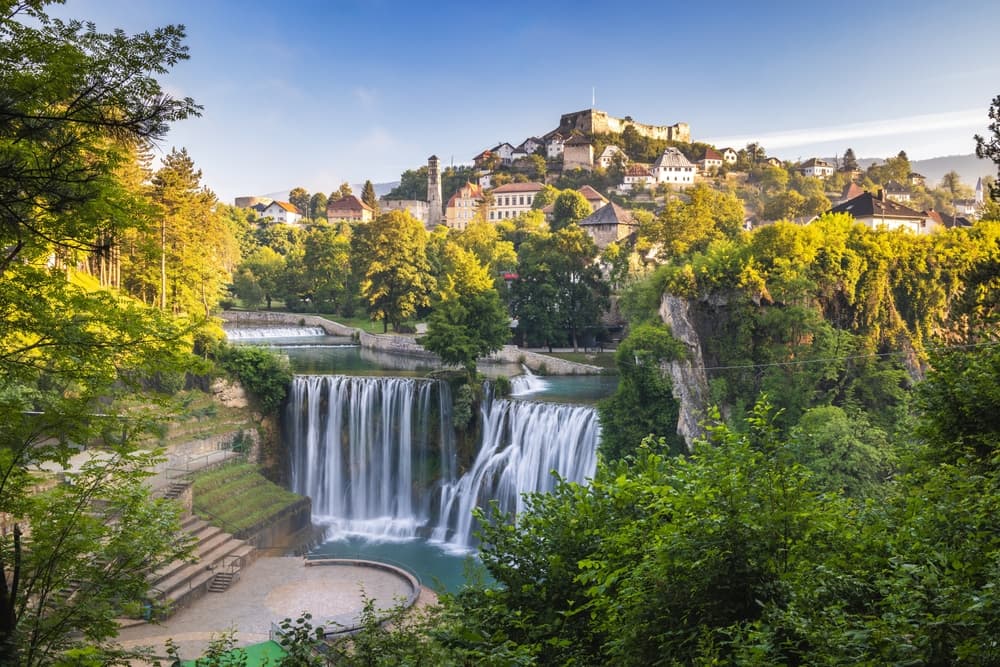
Travnik, the former capital of Ottoman viziers between 1699 and 1850, preserves the layout of its perched fortress and the birthplace of Ivo Andrić, 1961 Nobel Prize winner in Literature and author of The Bridge on the Drina. The old town lines up its mosques, including the Painted Mosque (Šarena Džamija) with its facade decorated in floral frescoes, rare in Ottoman lands. An hour's drive further west, Jajce was the last capital of the independent Bosnian kingdom: its 22-meter waterfall plunges into the city center at the confluence of the Pliva and Vrbas rivers, and medieval catacombs carved into rock bear witness to the royal court of the 15th century.
Further south, Kraljeva Sutjeska and its Franciscan monastery founded in the 14th century preserve a collection of sacred metalwork and manuscripts linked to the medieval Bosnian Church. The neighboring village of Bobovac shelters the ruins of the royal fortress where Bosnian kings were crowned. Visoko, 30 kilometers from Sarajevo, became famous from 2005 for pyramids supposedly identified by Semir Osmanagić, a hypothesis rejected by the scientific community but which draws notable tourist traffic around tunnels and earthworks.
Regional cuisine revolves around lamb cooked under the sač (cast-iron bell covered with embers), Travnik cheese (Travnički sir) aged in brine, and trout from the Pliva lakes. The towns of the Lašva valley are also former centers of textile and leather production, and certain factories in Vitez or Busovača remain active. The human fabric is mixed: Bosniak Muslims, Catholic Croats and Serbian Orthodox live here in a village geography that was one of the hardest hit by the 1992-1995 war, particularly in the Lašva valley.
In landscape terms, two sites stand out. The Kravice waterfalls, about two hours to the south, are found in Herzegovina and are often erroneously associated with the central region; here, it is rather the ensemble of Plivsko lakes (Veliko and Malo Plivsko) near Jajce that offer summer swimming and a line of wooden water mills on the Pliva river, listed as national heritage. The Vlašić massif, at 1,933 meters at the Paljenik summit, is the homeland of sheep cheese of the same name and a modest ski domain in winter.
The region is easily traversed by the M5, the former imperial road linking Sarajevo to Bihać following the valleys. It was along this corridor that trade caravans passed linking Istanbul to the Adriatic, which explains the density of caravanserais, stone bridges and medieval tombs (stećci) you encounter every twenty kilometers.
To discover
Travnik and Andrić's house. The 15th-century fortress dominates the old Ottoman town, and the birthplace of the 1961 Nobel Prize winner displays objects and manuscripts by the author. Allow half a day with lunch of ćevapi or lamb.
Jajce, waterfall and royal catacombs. 22-meter cascade in the heart of the city, medieval citadel and catacombs carved beneath Saint Luke's church, remains of the last Bosnian court before 1463.
Wooden mills of Lake Plivsko. Around twenty small water mills lined up on rapids between the two Pliva lakes, still used to grind corn. Particularly beautiful light in late afternoon.
Kraljeva Sutjeska Monastery. 14th-century Franciscan foundation in a wooded valley, with treasures of metalwork and an ancient library. Combine with a hike to the ruins of the royal fortress of Bobovac (2 hours round trip).
Highland cheeses of Vlašić. Drive up the forest road to the katuns, summer hamlets between 1,200 and 1,600 meters, where herders produce Vlašić sheep cheese in 5-kilo wheels. Tasting possible from June to September.
When to go
The most pleasant window runs from mid-May through late September. In May-June, the valleys are lush, temperatures hover between 18 and 24 °C during the day, and rivers remain swollen by snowmelt. July and August reach 28-32 °C in the valley floors but remain bearable at higher elevations (Vlašić, Vranica) where you easily lose 8 to 10 °C. September and the first half of October offer autumn colors over the beech forests and light crowds.
Winter is harsh: Travnik and Jajce regularly receive 30 to 60 centimeters of snow between December and February, and passes above 1,200 meters remain closed or difficult until April. March and April are rainy transition months, with secondary roads sometimes muddy. If you come in winter, it's for cross-country skiing on Vlašić or the atmosphere of snow-covered towns, not for high-altitude hiking.
Practical advice
Three to four days allow you to cover the essentials: one day Travnik and Vlašić, one day Jajce and Plivsko lakes, one day Kraljeva Sutjeska, Bobovac and Visoko on the return to Sarajevo. The logical entry point is Sarajevo airport, 30 minutes from Visoko and 1h30 from Travnik via the M5. The region naturally combines with Sarajevo and surroundings at the start or end of your stay, and with Krajina and Una National Park by continuing west from Jajce (2h30 to Bihać).
The comfort level is decent without being high-end: family guesthouses in Travnik and Jajce, a few three-star hotels, few luxury options. This region suits travelers curious about medieval and Ottoman history, lovers of villages and local products, and hikers seeking little-frequented trails on Vlašić or Vranica. Less suited to families with very young children if you're visiting multiple historical sites, but the Plivsko swimming and mills make good breaks.