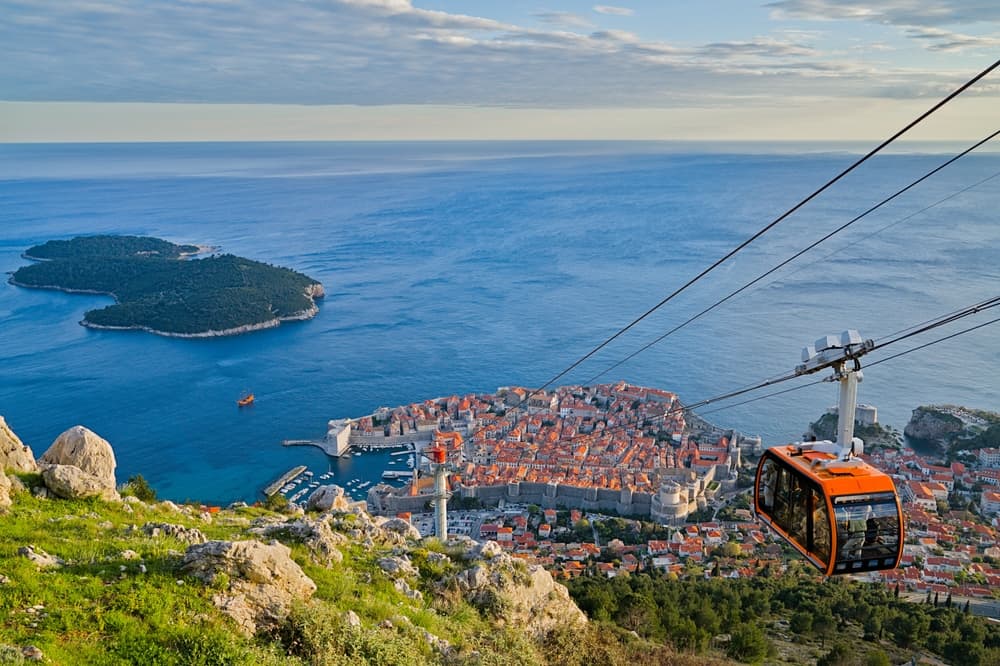
Southern Dalmatia and Dubrovnik
From Ploče to the Montenegrin border, the southernmost tip of Croatia brings together walled Dubrovnik, the wine peninsula of Pelješac, the oysters of Ston and Mljet National Park.
Southern Dalmatia begins beyond the Neretva delta at Ploče and stretches roughly 140 km to Kotor Bay in Montenegro. This narrow coastal strip is wedged between the Dinaric limestone massif and the Adriatic, with a distinctive geopolitical quirk: the Bosnian municipality of Neum cuts through Croatian territory for 9 km, requiring a double border crossing on the national D8 road. Since 2022, the Pelješac Bridge bypasses this enclave across the sea and has brought Dubrovnik within 2 hours 15 minutes of Split by car.
Our team based in the capital works this region around three geographic axes. First, the Pelješac peninsula, 70 km long, a schist ridge planted with terraced vines on its southern slopes, where the plavac mali grape yields the country's most full-bodied reds on the steep slopes of Dingač and Postup. At its base, the fortified village of Ston lines 5.5 km of medieval ramparts and has operated saltworks since the 14th century; the flat oysters from Mali Ston bay, Ostrea edulis, are eaten raw at the quay for roughly 2 euros each.
Next comes the Elaphites archipelago and the island of Mljet, accessible by ferry from Prapratno or catamaran from Dubrovnik. The western third of Mljet has been designated a national park since 1960 around two salt-water lakes, Veliko and Malo Jezero, connected to the sea by a narrow channel. In the middle of the larger lake, the islet of Santa Maria bears a 12th-century Benedictine monastery. The island is sparsely inhabited, with 1,100 permanent residents, and maintains beekeeping and olive oil production.
Finally, Dubrovnik itself, the former maritime republic of Ragusa, which negotiated its independence against Venice, the Ottomans and Napoleon until 1808. The walled old town fits within 0.2 km² and concentrates the baroque cathedral, the Rector's Palace, the Franciscan pharmacy from 1317 still in operation, and the Stradun paved with polished limestone. The ramparts form a loop of 1,940 metres to walk in approximately 1 hour 30 minutes. We warn our travellers: with up to 10,000 cruise passengers disembarking on some summer days, the city becomes congested between 10 a.m. and 4 p.m. Walking the ramparts at opening time, around 8 a.m., radically changes the experience.
The climate is Croatia's most temperate, frankly Mediterranean with a winter average around 9 °C in Dubrovnik and summers at 28-30 °C tempered by the maestral breeze. The sea remains swimmable from late May to early October, around 23 °C in September. This mildness explains the presence of citrus, fig trees, carob and cypress that structure the landscapes, as well as a cuisine leaning more towards seafood and olive oil than in the north of the country. The local specialty, pašticada, is braised beef in sweet prošek wine served with gnocchi, a typical Sunday family meal dish.
The region works well as a starting or finishing point for an itinerary, with Dubrovnik-Čilipi airport served by direct flights from Paris, Lyon, Marseille, Brussels and Geneva in season. It logically combines with Central Dalmatia along the coast, and also allows extensions to Kotor and Boka Bay in Montenegro, 2 hours' drive away, or to Mostar and Kravice waterfall in Bosnia and Herzegovina, 2 hours 30 minutes away.
To discover
Dubrovnik ramparts at dawn. A 1,940-metre loop along the walls at ticket office opening around 8 a.m., before the cruise ships. Sweeping views of the roof tiles restored after the 1991-1992 bombardments and the wooded islet of Lokrum.
Salt lakes of Mljet National Park. Cycling or hiking tour around Veliko Jezero, shuttle crossing to the Benedictine monastery on the Santa Maria islet, swimming in water at 24 °C in July. The island can be visited in a day trip from Dubrovnik or as a two-night stay in Pomena.
Ston oysters and salt ramparts. Tasting at the quay with oystermen of Mali Ston bay, then climbing the 5.5 km ramparts that once connected Ston to Mali Ston to protect the saltworks, Europe's second-longest defensive wall after the Great Wall of China.
Pelješac wine route. Caves at Potomje and the 1974 tunnel road carved to reach the Dingač vineyards, plots at 45° above the sea where harvesting is still done on donkey-back. Plavac mali tastings at producers Grgić, Miloš or Bartulović.
Elaphites archipelago by boat. Three car-free inhabited islands 1 hour from Dubrovnik: Koločep, Lopud with its Šunj sand beach, Šipan with Renaissance villas of Ragusa shipowners. Day trips by water taxi or public Jadrolinija shuttle.
When to visit
The useful season runs from late April to mid-October. May and June offer the best conditions: 22 to 27 °C, sea at 20-23 °C from mid-June, flowering trails on Pelješac and Mljet, still moderate crowds in Dubrovnik. July and August reach 30-32 °C during the day with very heavy footfall in the old town and accommodation prices doubling; we then direct travellers to quieter bases like Cavtat, Trsteno or the Pelješac peninsula, with shuttles to Dubrovnik early morning. September is the season we most heartily recommend: 26 °C, sea at 23-24 °C until early October, grape harvest on Pelješac, cruise passengers declining after the 15th.
From November to March, the climate remains mild, 9 to 14 °C, but rainfall is marked, 150 mm in November, and many facilities on Mljet, Pelješac and the Elaphites close from November to Easter. Walled Dubrovnik remains lively year-round and is pleasant to visit in December during the holidays, with a Christmas market on the Stradun and temperatures rarely dropping below 6 °C at night.
Practical advice
We recommend a minimum of 4 full days in the region: 2 nights in Dubrovnik for the old town and ramparts at the right time of day, 1 night on Mljet to enjoy the national park beyond a day excursion, 1 to 2 nights on Pelješac between Orebić, Ston and wine estates. With 6 days, you can comfortably add the Elaphites and an excursion to Kotor or Mostar. Entry is via Dubrovnik-Čilipi airport, 22 km south of the city, or by road from Split, 220 km via the Pelješac Bridge.
The region combines very well at the start or end of an itinerary with Central Dalmatia and islands, heading up through Korčula, Hvar and Split, or as part of a longer loop via Northern Dalmatia and Plitvice. The comfort level is high, with a range of boutique hotels and quality villas, but summer prices in Dubrovnik are the highest in the country. This region suits travellers in couples, heritage and gastronomy enthusiasts, and contemplatives who take time to split between historic city and islands. For families with young children, we favour quieter bases like Cavtat or Pelješac, with direct access to the sea.