Northern Dalmatia
Between Zadar and Šibenik, 150 km of jagged coastline carved by the 89 islands of the Kornati and the waterfalls of the Krka—our favorite sailing ground away from the crowds.
Northern Dalmatia stretches along the Croatian coast between Pag to the north and the Krka to the south, roughly 150 km of shoreline carved by four archipelagos: Pag, Zadar, Kornati, and Šibenik. The landscape here is less dramatic than central Dalmatia, but the concentration of inhabited islands and remote islets makes it our preferred playground for sailing. From our offices in Zagreb, we reach the coast in 2.5 hours via the A1 motorway, which crosses the Velebit massif through the Sveti Rok tunnel, stretching 5.7 km.
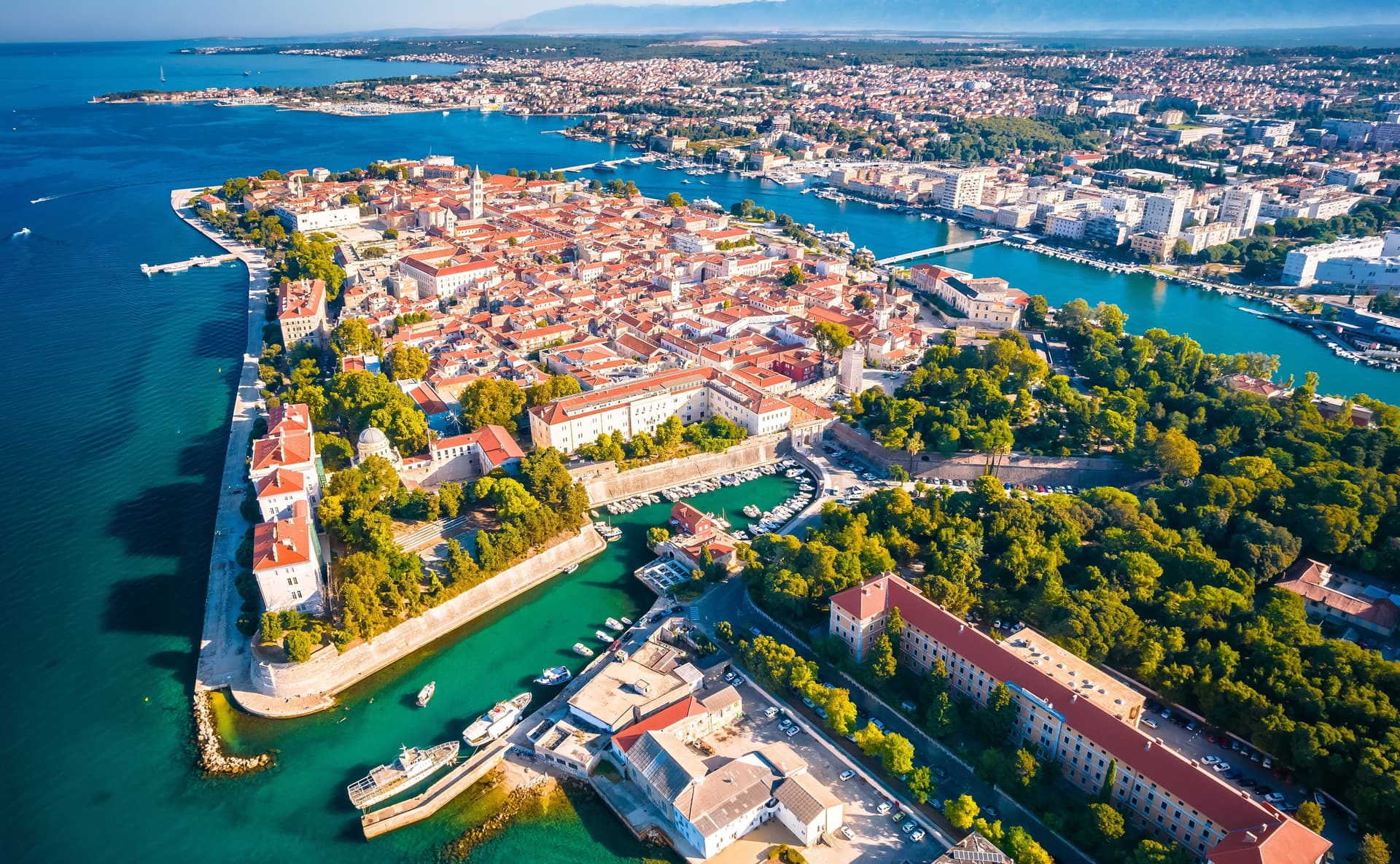
Zadar remains the region's historic capital. The old town occupies a 600-meter peninsula built atop the foundations of the Roman city of Iader. A 1st-century forum sits alongside the 9th-century pre-Romanesque Church of Saint Donatus, constructed from recycled stones of the forum itself. Along the western promenade, the Sea Organ conceived by architect Nikola Bašić in 2005 produces random chords as waves surge beneath it, standing beside his installation Greeting to the Sun. With 75,000 inhabitants, the city thrives on tourism alongside its fishing port and university, sustaining local life beyond the season.
Šibenik, 75 km south, occupies a singular position: the town sits at the mouth of the Krka River, in a narrow bay connected to the sea by Saint Anthony's Channel. Its Cathedral of Saint James, built in Brač stone between 1431 and 1535 without any mortar, is inscribed on the UNESCO World Heritage list. Four fortresses overlook the town, including Saint Michael, recently restored as a concert venue. Lacking Zadar's airport and fame works entirely in its favor.
The Kornati form the Mediterranean's densest archipelago: 89 islands, islets, and reefs across 320 square kilometers, most without fresh water or permanent inhabitants. Shepherds from Murter and Sali once drove their flocks here seasonally, leaving behind dry-stone walls that still pattern the slopes. The national park has protected the southern section since 1980. The western cliffs, called korune or crowns, plunge to depths of 80 meters. We organize outings from Murter, where the fishing boat captains know the best anchorages.
The Krka, the region's second national park, follows its namesake river for 73 km from Knin to the sea. The Skradinski buk waterfalls cascade over 17 tiers, dropping 46 meters in total. Swimming has been prohibited since 2021 to preserve the travertine formations. Upstream, the islet of Visovac holds a Franciscan monastery founded in 1445, accessible by boat from Stinice. The Krka canyon between Roški slap and Knin sees few visitors, ideal for those seeking to avoid the tour buses that choke Skradin in July and August.
The hinterland tells a different Dalmatian story. The Bukovica and Ravni Kotari, karst plains between Benkovac and Knin, bear heavy scars from the 1991–1995 war. Many villages continue to depopulate, yet some families are reviving production of olive oil, pršut (wind-dried ham from the bora), and Pag cheese aged in oil. On Pag itself, the mineral landscape of the wind-swept northwest gives the cheese its characteristic salty tang. At the table, seek out brodet—a fish stew with polenta—šurlice pasta, and black cuttlefish risotto.
Must-see experiences
Sailing in the Kornati. Day excursion by boat from Murter through the 89 karst islands of the archipelago, with anchorage in a secluded bay and lunch of grilled fish at a shepherd's home on Žakan or Levrnaka.
Krka waterfalls and monastery. A roughly 2 km walk across wooden boardwalks between the Skradinski buk cascades, followed by a boat crossing to the islet of Visovac to visit the Franciscan monastery and its library of glagolitic manuscripts.
Zadar at sunset. A walk along the western point to listen to Nikola Bašić's Sea Organ, with the Zadar channel and the silhouettes of Ugljan and Pašman islands as your backdrop.
Šibenik Cathedral and Saint Michael Fortress. Visit the Cathedral of Saint James, assembled entirely in stone without mortar, followed by a climb to the fortress for an all-encompassing view of the bay and the entrance to Saint Anthony's Channel.
Cheese producers on Pag Island. Meet a paški sir producer near Kolan, taste sheep's cheese aged for 12 months, and traverse the lunar landscape of northern Pag, sculpted by the bora wind.
When to visit
The ideal window spans mid-May through mid-June and early September through mid-October. Daytime temperatures hover around 24–27 °C, the sea holds 21–23 °C, and sites like Krka and Zadar can be explored without summer crowds. In July and August, temperatures climb to 30–32 °C, sometimes 35 °C during heat waves, and national park parking lots fill by 10 a.m. We advise against this season unless your trip centers on sailing, where crowds thin as soon as you leave the coast.
Winter is mild but windy: the bora descends from the Velebit in gusts of 100–150 km/h, particularly between Karlobag and the Pag Channel, occasionally closing bridges and suspending ferry service. Rain concentrates in November and March, averaging around 100 mm monthly. The Bukovica hinterland experiences greater temperature swings than the coast: expect 5–7 °C cooler inland in winter, with more frost around Knin.
Practical advice
We recommend 4 to 6 days in the region to combine Zadar, a day at Krka, a day sailing the Kornati, and a detour to Pag or the Bukovica. With fewer than 3 days, you must choose between the two national parks, which would be a shame. Zadar airport receives direct flights from Paris, Lyon, Brussels, and Geneva from April through October; outside the season, arrival is via Zagreb with 3 hours of driving, or Split 1.5 hours to the south.
Northern Dalmatia naturally pairs with Plitvice and the interior karst by heading north (2 hours to the lakes), with central Dalmatia and islands by heading south toward Split, Brač, and Hvar, or with Istria via a long day's transfer of 4.5 hours. Lodging is comfortable without luxury: we work with family-run guesthouses in Šibenik, a few boutique hotels in Zadar's old town, and agritourism properties in the hinterland. The region suits families with swimming children, sailing enthusiasts, and contemplatives willing to walk 2–3 hours daily. Serious hikers will prefer Velebit or Paklenica, just to the north.