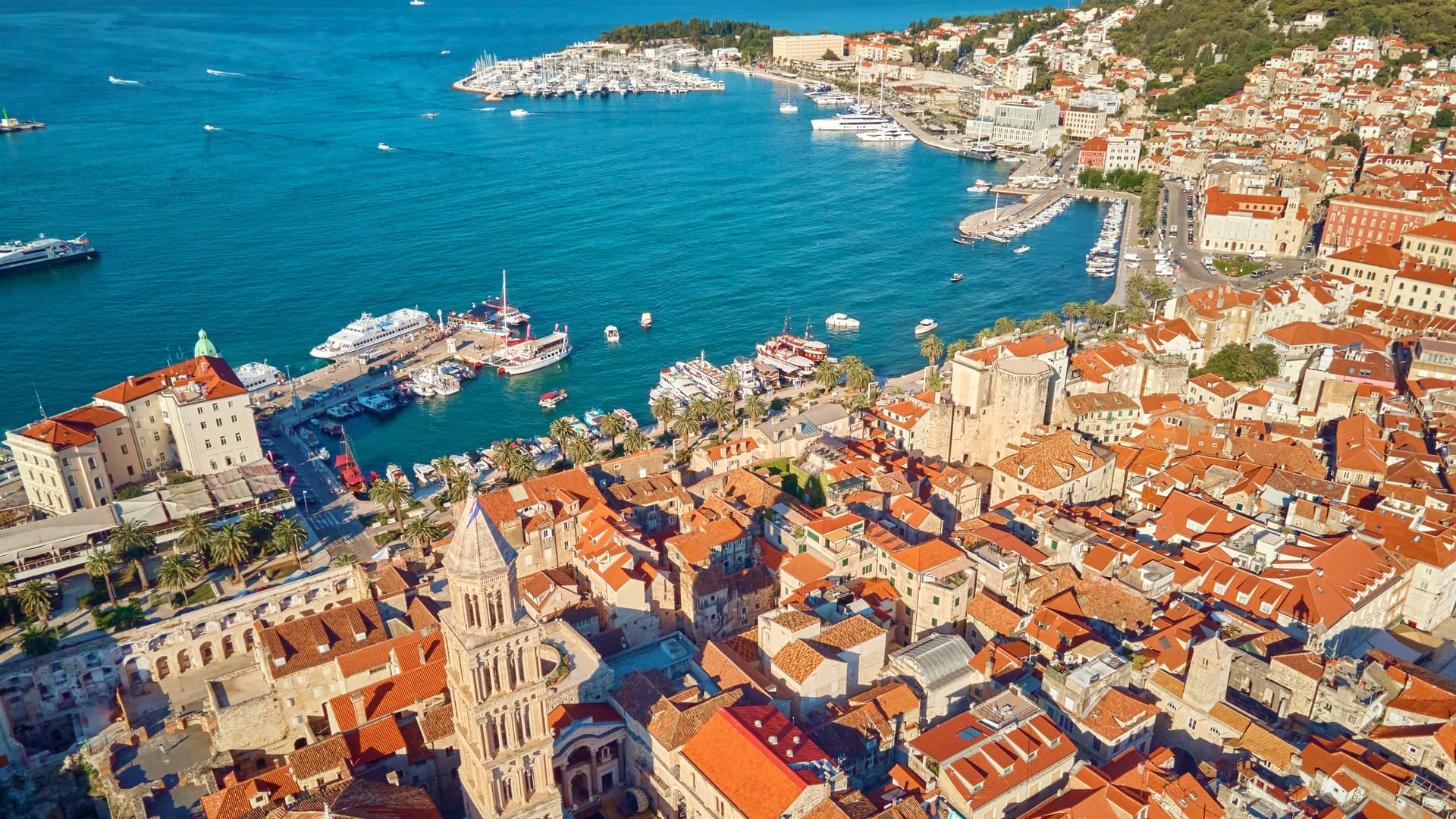
Central Dalmatia and Islands
Split and its palace inhabited for 17 centuries open onto the archipelago of Brač, Hvar, Vis and Korčula, each with its own rhythm, wines and stone villages.
Central Dalmatia stretches between the foothills of the Mosor massif and the chain of islands that closes the horizon from Split: Brač, Šolta, Hvar, Vis, Korčula. It is a karst coastline, white and mineral, where limestone crops up everywhere, even in the walls that border the vineyards of Bol or Jelsa. Split, anchored around Diocletian's Palace completed in 305, is not an open-air museum: 3,000 people still live within the ancient walls, and the Peristyle still serves as a neighborhood plaza in the early morning, before ferries discharge day-trippers.
The region draws its identity from this dual belonging, both continental and insular. On land: Trogir with its medieval center inscribed on the Unesco list, the Kaštela plain covered in olive groves, then the hinterland of the Cetina River, which emerges from the gorges near Omiš after a 105 km journey from the Dinara. At sea, each island has its own logic: Brač lives by stone, extracted since antiquity in the quarries of Pučišća where Diocletian's Palace and the White House in Washington sourced their material. Hvar divides its population between the sunny, wine-rich south coast and the inland plateau where abandoned hamlets still remain from the rural exodus of the 1960s, like Malo Grablje.
Vis, 45 km offshore, merits separate treatment. Closed to foreigners from 1950 to 1989 as a Yugoslav naval base, it escaped the tourism pressure of its neighbors. You can still find military tunnels carved into the rock, submarines sheltered in caves near Rogačić, and two main ports: Vis Town and Komiža, where net fishing is still practiced. The gastronomy is austere: octopus cooked under a peka (cast-iron bell covered with embers), pogača from Komiža (pie with anchovies and onions), Vugava and Plavac mali wines from the Plisko Polje slopes.
Korčula closes the archipelago to the south. The old town, laid out in a fishbone pattern to break the bora and jugo winds, houses the so-called house of Marco Polo, whose birth here is disputed but claimed. The island's interior lives off Pošip wine from Čara and Smokvica, and the Moreška dance, a choreographed saber combat passed down since the 16th century, performed several times weekly in season on the square near Saint Mark's Cathedral.
The climate is distinctly Mediterranean, with dry summers where July and August hover around 30 to 33°C on the coast, and mild but windy winters. The mistral, a northwest thermwind, picks up mid-day and brings relief from the heat. The bora, descending from the Velebit, can sever ferry connections for several days in winter. The cuisine reflects this context: olive oil from Brač and Šolta, pašticada lamb braised in Prokupac wine, seafood from the Drvenik and Marina hinterland, and brudet, a fish stew served with white polenta.
For our team based in Zagreb, this region concentrates the classic promise of coastal Croatia, but it does not reveal itself in two days. Split serves as a hub: international airport, Jadrolinija ferry port serving the five main islands, bus station for reaching the hinterland. The density of options and the inherent slowness of maritime journeys (1 hour to Brač, 2 hours to Hvar by catamaran, longer for Vis and Korčula) mean you must choose, not do everything.
To Discover
Diocletian's Palace in Split. The intact 4th-century basement, the inhabited alleys between ancient columns, and the vegetable market against the east wall, where Split residents still come for their Saturday morning shopping.
Crossing Hvar through its interior. From Stari Grad to Hvar Town passing through the wine plateau and depopulated hamlets of Velo and Malo Grablje, partly restored by a family that serves lamb and Bogdanuša wine at lunch.
Vis and the Biševo archipelago. The blue grotto of Biševo, accessible by boat from Komiža between 11am and noon for the light, followed by a return via Stiniva Bay, a cove ringed by two limestone walls 40 meters high.
Quarries and villages of Brač. The stone-cutting school of Pučišća, operating since 1909, where students still work with chisels, then a climb to the summit of Vidova Gora (778 m), the highest peak of the Adriatic islands.
Moreška of Korčula. Saber dance performed on the old town square several evenings a week in summer, a remnant of a Mediterranean choreographic repertoire extinct everywhere else.
When to Go
The season runs from mid-May to early October. June and September offer the best balance: sea at 22-24°C, air temperatures between 24 and 28°C, clear light without the tourist saturation of Hvar Town in July-August. These last two months concentrate the crowds, hotel prices double in Bol and Hvar, and ferries to Vis require booking one to two weeks in advance.
April and October remain manageable for contemplatives and hikers, with 18 to 22°C during the day, but the sea drops below 18°C and several island restaurants close out of season, especially on Vis and the northern coasts of Brač. Winter is very quiet: Split functions year-round, but inter-island connections are reduced and the bora can disrupt rotations for 24 to 48 hours. Rain falls mainly between November and March, in the form of short but intense episodes.
Practical Advice
Allow a minimum of 5 days to combine Split and two islands, 7 to 8 days to explore three islands at a sustainable pace. Split Airport (Kaštela) is the logical entry point, with direct flights from Paris, Brussels, Geneva and Lyon in season. We tailor itineraries to Jadrolinija (car ferries) and Krilo (fast passenger catamarans) schedules, avoiding island-hopping on the same day, which is unrealistic beyond Hvar.
The smoothest combination is with Southern Dalmatia and Dubrovnik, accessible from Korčula by ferry, or with Plitvice and the interior karst on your way up the coast. For a more contrasted journey, Istria complements well with its cultural difference (Italian influence, truffles, small ports) after descending the coast. The region suits contemplatives, archaeology and seaside gastronomy enthusiasts, couples seeking a mix of cities and swimming, and families with teenagers if you avoid the July-August crowds. Hotel comfort ranges from boutique hotels within Diocletian's Palace to stone houses for rent on Vis or Šolta.